 National Wire About Nigerians, Nigerian Business and Other Stories


The Executive Director of Media Rights Agenda (MRA), Mr. Edetaen Ojo has expressed grave concern over the persistent assaults on journalists and freedom of expression in Nigeria.
Addressing participants at the event organised to commemorate the World Press Freedom Day 2024 held at the International Press Centre Lagos yesterday, Ojo highlighted, “The culture of impunity is what we really need to combat,” stressing the urgent need to address the prevailing threats to press freedom.
Ojo, while outlining MRA’s extensive efforts in documenting attacks on journalists and media freedom, lamented the growing trend of violence against journalists during President Bola Tinubu’s first year in office.
He emphasised that “These attacks, range from arbitrary detentions to threats and physical violence, signify a disturbing pattern of aggression against journalists.”
Providing statistical insights, Ojo revealed, “Between May 2023 and April 2024, MRA recorded at least 45 attacks on journalists and media houses,” with the majority of victims being male journalists.
He also underscored the alarming involvement of law enforcement agencies in perpetrating these attacks.
Echoing Ojo’s sentiments, Mr. Lanre Arogundade, Executive Director of the International Press Centre (IPC), emphasised the theme for this year’s celebration: “A press for the planet: Journalism in the face of the Environmental Crisis.”
Arogundade underscored the significant challenges journalists encounter in fulfilling their duties, calling for concerted efforts to establish a national media mechanism in Nigeria.
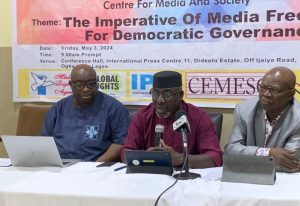
Furthermore, Dr. Akin Akingbulu, representing the Centre for Media and Society (CEMESO), reiterated the critical importance of safeguarding journalists’ safety. He revealed that attacks on journalists, ranging from arrests to assassinations, were disturbingly frequent, with state actors accounting for a majority of the assaults.
Also at the event, journalists shared experiences on attacks suffered while carrying out their lawful duties.
Mr. Clinton Umeh of Journalists 101, Ms. Khadija Yahaya of Arewa Radio, Ms. Charity Uwakwe of Famous Reporters, Mr. Eniola Daniel of The Guardian newspaper, and Mr. Benedict Uwalaka of Daily Trust newspaper, shared their testimonies highlighting the challenges faced by journalists and the impact of attacks on their well-being and professional endeavors.
Subsequently, Dr. (Mrs.) Uzochukwu Israel, a Clinical Psychologist from the University of Lagos, made a presentation on the “Possible Psychosocial Effects of Attacks on Journalists and their Management.”
Dr. Israel emphasised the potential mental and physical health implications of trauma experienced by journalists, providing strategies for self-management and stressing the importance of seeking professional help when necessary.
The event, jointly organised by MRA, IPC, and Global Rights, underscored the urgent need for collective action to ensure the safety and freedom of the press in Nigeria.
Executive Director of Media Rights Agenda (MRA), Mr. Edetaen Ojo has decried the regular attacks on journalists and freedom of expression in Nigeria.
Ojo in his opening remark at an event to mark the World Press Freedom Day 2024 at the International Press Centre (IPC), Lagos, yesterday, said, “The culture of impunity is what we really need to combat.”
He said, the MRA throughout it’s existence as an organisation, has tracked attacks on journalists, attacks on media freedom, attacks on freedom of expression.
“We have tried to offer various forms of assistance from time to time including most recently providing litigation assistance to victims of such attacks, our experience in this regard has been very neat, we have recorded some successes and we have also been unable to secure favourable outcomes”, he explained.
Continuing, Ojo said, “The first year of President Bola Tinubu has witnessed several attacks on journalists and media institutions by various actors including state actors.
“Covering the first year in office of president Bola Tinubu, we have been very disappointed and disturbed by the numerous attacks on journalists and media houses across the country,” he lamented.
Documenting the attacks, Ojo said the attacks do not recognise gender as they happened to both male and female journalists within the monitored period.
Providing useful data, Ojo said, “To just provide some data, between May 2023 and April 2024, MRA recorded at least 45 attacks on journalists and media houses, In 37 of these attacks, the victims were male journalists representing 82 percent of total attacks while four of the attacks were focused on female journalists.
Talking about the perpetrators of the attacks, Ojo said law enforcement officials that should protect journalists were among the culprits.
“In terms of the perpetrators of the attacks, out of the 45 cases of attacks that we documented, law enforcement and security agencies were responsible for 62 percent of the attacks while hoodlums and thugs represent 16 percent of these attacks with unidentified persons such as kidnappers armed individuals and so on represented 15 percent of the attacks.”
According to him, “Although some of these attacks were not by security agencies but the responsibility of the state to ensure that there is no impunity against journalists sadly remains unfulfilled so typically we cannot find any single instance where any of the perpetrators have been arrested, prosecuted or otherwise held accountable the result that the impunity continues to thrive.
“We are working with our partners to develop tools to enable us better track, document and response to attacks on journalists and their media freedom in general we hope to be able to do that in the coming month. We are also engaged on discussion to establish a national mechanism on the safety of journalists and part of the function of such mechanism is to ensure accountability on attack against journalists in the abuse of power always inherent on. We need to focus on attacks coming from law enforcement and security agencies while thriving while trying to ensure there is no more impunity.
“In pursuance of this we also need to establish a legal assistance program supported by dedicated forum with the ultimate objective that no attack on media organisation and journalists go unchallenged, that is our ultimate goal. We also believe that there is need for a specific legislation to protect journalists and the media consistent with the requirement of relevant internal and regional laws. We will also be directing our efforts towards this objective in the coming months and years,” he explained.
In his own comment, Executive Director of the International Press Centre (IPC), Mr. Lanre Arogundade at the event emphasising the theme for the year’s celebration which is “A press for the planet: Journalism in the face of of the Environmental Crisis”, talked extensively about IPCs findings on the attacks on journalists in 2023.
“We wish to highlight the enormous difficulties in what journalists across the country face in discharging their lawful duties. We hope that all relevant stakeholders will work together to ensure that the national media mechanism in Nigeria is put in place,” he said.
“We did our findings through media monitoring of attacks on journalists and using a group of monitors working on different geopolicial zones to monitor the veracity of the attacks on the media and ensure that we do not go out to provide the wrong information, he explained.
Going into the data gathered from by his organisaton, Arogundade said, “So from our own data we had about 33 cases of attacks on journalists and the media. The 33 instances involved 44 journalists and six media outlets in terms of gender we have 35 male journalists and nine male journalists and it also shows that these attacks do not know gender.
“We also looked at the location of these attacks in terms of Nigeria’s geopolitical zones, in the south east there were three, in the south west there were 11 and the south south 11, in the north west there were seven and north central, eight and north east, four. The majority of the attacks took place in the south west and the south south.
“We are working on institutional framework that will assist the protection of journalists. We are also working on capacity building for journalists,” he said.
The event put together by the MRA, IPC, Global Rights also featured on the panel, Dr. Akin Akingbulu, who heads the Centre for Media and Society (CEMESO).
He gave the reports of his organisation’s involvement in the fight against attacks on journalists, media organisaitons and press freedom in Nigeria.
According to him, “The safety of journalists is a front burner issue in Nigeria and the world. Journalists continue to face treats on duty and implication for the society and contribution to democracy and development, our organisation has been involved in tracking freedom of the press for many years as well, on a daily basis we track the issues and share what we see on many platforms”.
“The report from our findings identifies two categories of attacks on journalists which involves personal and individual attacks or the corporate attack.
In 2023 at least, 90 percent of the attacks were personal or individual, in 2023 we saw that journalists were subjected to various forms of attacks ranging from arrests to assaults to detention, to denial of access to harassment to invasion, to abduction to arbitrary fines to assassination, attempted assassination, bombing, demolition , dismissal,” he relayed.
He also gave timelines of the documented attacks. “Timelines of these attacks are equally revealing. The attacks are virtually every month of the year but February and March were the worst and it will not be surprising because the attacks were around election period.
“August was not an election month yet in a singular attack, six journalists from different media houses covering a communal clash in Bayelsa State were involved.
“Under the individual attacks, analysis by gender says the majority of the journalists who fell into the different attacks were males, the attackers also have no respect for gender as female journalists were also attacked in the line of duty.,” he said.
“From our records, the attacks on institutions were 13 in form of invasion, denial of access, fine, bombing, demolition, the figures are there. Distribution of attack by state, the leaders were clearly Lagos, FCT and Kano States,” he stated.
“In all, 54 percent of the attacks on journalists and media organisations were perpetrated by state actors in 2023. Among them was the Nigeria police which ranked highest. Journalists are unsafe with state actors just as they are with non state actors,” he said.
Earlier in the summit,
journalists shared experiences on attacks suffered while carrying out their lawful duties.
Mr. Clinton Umeh of Journalists 101, Ms. Khadija Yahaya of Arewa Radio, Ms. Charity Uwakwe of Famous Reporters, Mr. Eniola Daniel of The Guardian newspaper, and Mr. Benedict Uwalaka of Daily Trust newspaper, shared their testimonies highlighting the challenges faced by journalists and the impact of attacks on their well-being and professional endeavors.
Subsequently, Dr. (Mrs.) Uzochukwu Israel, a Clinical Psychologist from the University of Lagos, made a presentation on the “Possible Psychosocial Effects of Attacks on Journalists and their Management.”
Israel emphasised the potential mental and physical health implications of trauma experienced by journalists, providing strategies for self-management and stressing the importance of seeking professional help when necessary.
Participants however brainstormed on ways to collaborate in defence of fellow journalists and freedom of the press in Nigeria.
Report by Dayo Emmanuel