 National Wire About Nigerians, Nigerian Business and Other Stories


By Dayo Emmanuel
In a country where domestic workers form an invisible but essential workforce, a clarion call has been made for the Nigerian government to recognize their rights, promote their welfare, and allow unionization.
At a one-day sensitization workshop organized by the Centre for Children’s Health Education, Orientation and Protection (CEE-HOPE) on Thursday, at the Dr. Nnimmo Bassey Hall in Lagos, activists, researchers, and educationists gathered to present the findings of a research project focused on domestic workers. The study, carried out with the support of the Rosa Luxemburg Foundation West Africa, sheds light on the often-overlooked plight of domestic workers in Nigeria and the urgent need for reforms.
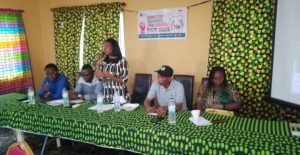
The event which was a gathering of stakeholders to further discuss domestic workers’ rights and strategize towards the formation of Domestic Workers unions featured a robust discussion to accelerate the unionization of domestic workers in Nigeria, many of who undergo untold hardship daily.
Dehumanization of Domestic Workers
Betty Abah, founder of CEE-HOPE, emphasized the alarming levels of abuse and neglect domestic workers face in Nigeria. “If there is any set of people that have been dehumanized, it is domestic workers—often called house helps,” she lamented. “They give them all manner of names because they don’t see them as human beings.”
Abah explained that most domestic workers are from impoverished backgrounds with limited or no formal education, making them vulnerable to exploitation and unable to seek redress.
“Since the COVID-19 period, we’ve been working on this issue every year. Now, we’re intensifying our efforts and pushing for the formation of union for domestic workers in Nigeria, just as they exist in countries like Kenya, Uganda, South Africa, and even the UAE and the United States,” she said.
According to Abah, achieving unionization is critical. “They need to have a voice of their own. Every progressive society must uphold human and labor rights. We also need employers, landlords, community workers, and other stakeholders to come together to ensure these rights are protected.”
Abah however ended with a strong call to action: “Domestic workers deserve dignity, protection, and a voice. Nigeria must not remain backward in recognizing those who do some of the most critical work in our society. Unionizing them is just the beginning.”
Groundbreaking Study
The event marked the official public presentation of a research publication by CEE-HOPE titled “The Working Condition and Rights of Domestic Workers in Nigeria”, supported by the Rosa Luxemburg Foundation West Africa.
Human rights activist and unionist, Hassan Taiwo Soweto, praised the research, calling it a reference point for advocates and stakeholders. He noted that domestic workers are not even regarded as “workers” under Nigerian law.
“This work goes deep into understanding the challenges and plights of domestic workers,” Soweto said. “It reveals that they often work in hazardous conditions with inadequate legal protection. They face long hours, emotional and physical abuse, and even sexual violence—without any viable channel for redress.”
The research, conducted by Soleye Abdulaziz Lekan, Auwal Mustapha, and Betty Abah, explored four key themes: the working conditions of domestic workers, existing efforts to protect their rights, obstacles to these efforts, and possible solutions. Twelve major challenges were identified, including legal invisibility, abuse, and child labor. Soweto emphasized, “Domestic work in Nigeria is dangerously close to child labor. The legal system must acknowledge and address this.”
Value of Domestic Work
Activist Lolade raised the crucial question: What is the true value of domestic work? She argued that society underestimates the economic and emotional contributions of domestic workers. “If women are considered time-poor due to childbirth and caregiving, how much more these domestic workers who shoulder caregiving without compensation or rights?” she asked.
Lolade pointed out that despite previous efforts from the International Labour Organization (ILO) and Nigeria Labour Congress (NLC), the Nigerian government remains largely unresponsive. “If the government truly wanted to address these issues, they would. Saying there are enough laws already in place is a way of avoiding action. We must hold the government accountable,” she insisted.
She also emphasized the root causes of domestic servitude—poverty and illiteracy. “If poverty is addressed, many young girls and boys would not be forced into domestic work. We must empower organizations like CEE-HOPE that advocate for these workers. The media also has a role to play in amplifying their voices.”
Rethinking Who a Worker Is
One of the participants, Mr. Adebayo, challenged the audience to rethink the very definition of a “worker.” “People often think a worker is someone in a formal job collecting a salary. But a true worker is anyone who works and should be entitled to the benefits of labor—regardless of whether they’re in the formal or informal sector,” he explained.
He also touched on gender roles and how domestic work is often undervalued because it is perceived as “women’s work.” “Some men make their wives full-time housewives—essentially domestic workers without pay. We must break this cycle starting from our homes and schools by challenging gender stereotypes.”
Adebayo called for campaigns in schools and communities to redefine gender roles and sensitize the public about informal labor. “This systemic issue cannot be solved without cultural reorientation,” he said.
Call for Swift Union Registration
Mr. Makinde, Head Teacher at Oke Ira Primary School, urged the organizers to expedite the unionization process for domestic workers. “We need to move quickly on registering this union,” he said. “Some of these children are abused, made to hawk for long hours, and threatened by guardians if they don’t sell enough. Some even repackage goods to make extra money to avoid punishment. We must act fast.”
Makinde called for reintegrating domestic worker-children into the school system. “If our schools are full, let them be taken to others. Some of these children are Yoruba, not just from the North. The practice cuts across tribes. We must expose adults who use these children under false pretenses and prosecute them when the law is finally in place.”
Global Protection and Nigeria’s Gap
Kadishi Oliseh, one of the researchers, explained the importance of ILO Convention 189—the Domestic Workers Convention—ratified by only 38 countries so far. Nigeria, regrettably, has not ratified it.
“This treaty, adopted on June 16, 2011, is the most comprehensive global legal instrument for domestic workers. It covers working hours, wages, contracts, abuse, and the right to rest, annual leave, and social protection,” Oliseh said.
She highlighted key articles from the Convention:
Article 1 establishes domestic work as a global issue deserving equal labor rights.
Article 7 requires written contracts specifying terms and conditions.
Other provisions include daily and weekly rest periods, minimum wage, and protections against abuse.
“Without Nigeria’s ratification and implementation of this convention, domestic workers in the country remain unprotected and invisible under the law,” Oliseh added.
A Way Forward
The event concluded with a collective commitment to intensify the push for recognition and rights for domestic workers. Stakeholders agreed that unionization is a first major step, followed by advocacy for legal reforms and public education campaigns. With the support of partners like the Rosa Luxemburg Foundation West Africa, CEE-HOPE and its allies hope to drive systemic change.
Speaking at the event, nurse activist Toba Odumosun highlighted that the issue of exploitation is not limited to domestic work but cuts across several sectors in Nigeria. He noted that some employers deliberately prefer untrained workers to cut costs, often at the expense of professionalism and dignity.
“This exploitation is a common problem,” Odumosun stated. “As a male nurse, I’ve seen how professions associated with women are undervalued. Domestic work is viewed through a gender lens, seen as less deserving of good pay because it is associated with women’s unpaid labour.”
He traced the roots of the problem to broader economic inequalities, pointing out that in the past, a single income could support an entire household. Today, due to economic hardship, many households depend on low-paid and often unregulated labour such as domestic work. “The real issue is the economy,” he emphasized. “People now live by cutting corners. Whether it’s domestic work or auxiliary nursing, it’s exploitation driven by poverty.”
Odumosun also drew attention to similar patterns of abuse in the nursing sector, where unqualified individuals are exploited as auxiliary nurses in violation of regulatory standards.
Also speaking, Comrade Rufus Olusesan stressed the importance of organizing domestic workers into unions. “Any work without future prospects or legally defined working conditions is not decent work,” he said. “Without union protection, employers exploit domestic workers—overworking them beyond the 40-hour legal weekly limit, underpaying them, and violating their rights.”
He urged domestic workers to organize under Section 40 of the Nigerian Constitution, which allows all workers to form unions. “Unionizing is about defending rights and advancing workers’ welfare.”
He added that, “Even as the Senate President promised to include domestic workers in the N70,000 minimum wage, without proper legal backing and collective bargaining structures, those promises remain empty.”