 National Wire About Nigerians, Nigerian Business and Other Stories


By Dayo Emmanuel
The Centre for Children’s Health Education, Orientation and Protection (CEE-HOPE) has renewed calls for the recognition of domestic workers’ rights and the unionisation of the sector in Nigeria, describing the current conditions as unacceptable and unjust.
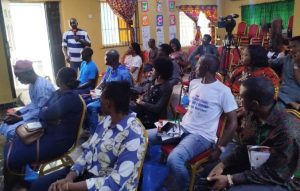
This was the thrust of a media consultation held at CEE-HOPE’s Lagos office in Agege on 17th October 2025.
The event brought together media executives, activists, and child rights advocates to strengthen collaboration in amplifying the voices of domestic workers and advancing the campaign for their protection and unionisation.
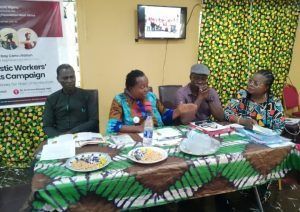
Speaking at the session, Executive Director of CEE-HOPE, Betty Abah, emphasised the urgent need to bring domestic workers under the umbrella of formal labour unions, saying it was the only way to ensure that their rights were protected.
“We need the media to magnify the voices of domestic workers,” Abah said. “In places like Dubai, domestic workers are well-paid professionals. They are respected and protected by law. It should not be different here. That is why we are calling for their unionisation and recognition.”
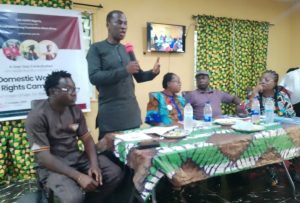
According to her, domestic workers form “the invisible backbone of society” whose contributions sustain households but who remain largely unrecognised and unprotected. “They care for our homes, nurture our children, and support our families—yet they are among the most vulnerable workers in Nigeria. Their labour has been invisible and unprotected for too long. That must change,” she said.
Abah further noted that the campaign aligns with Nigeria’s obligations under the ILO Convention 189 on decent work for domestic workers, stressing that protecting the majority of women and girls in this sector is both a human rights and social justice imperative.
She drew attention to two bills currently before the National Assembly—HB.1765, sponsored by Hon. Akin Alabi, which seeks to domesticate the “Domestic Workers Bill of Rights,” and SB.629, sponsored by Senator Sani Musa, aimed at regulating and formalising employment in the informal sector.
“These bills represent a historic opportunity,” she said. “If passed, they will guarantee fair wages, safe working conditions, access to social security, and legal recourse for domestic workers. It will also formalise a sector that has long existed in legal limbo and strengthen Nigeria’s image internationally.”
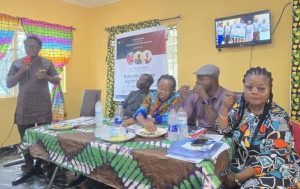
Abah emphasised that unionisation was critical to breaking the cycle of exploitation. “When workers come together, they can negotiate for better terms and resist abuse. Without a union, they remain voiceless; with one, they gain structure and protection,” she said.
She called on the media to play an active role in the advocacy. “The media is not just an observer—it is a partner. Your stories can bring the challenges of domestic workers into the light, drive public empathy, and mobilise support for policy reform. In Nigeria’s history, the media has always played a catalytic role in social progress. We need that leadership again.”
Abah concluded by reiterating CEE-HOPE’s long-term commitment: “Domestic workers are not servants—they are workers. Protecting their rights through legislation, unionisation, and advocacy is not charity; it is justice. CEE-HOPE will continue to work with the media, legislators, and labour groups until this becomes a reality.”
Domestic Workers Are Not Slaves
Media and development expert, Dr. Monday Ashibogwu, decried the poor treatment of domestic workers across Africa, describing it as a continuation of “modern-day slavery.”
“Domestic workers in Sub-Saharan Africa face dehumanising conditions,” he said. “Some are made to sleep in generator houses or endure abusive conditions because they chose domestic work. This is wrong. The dignity of labour must be protected.”
Ashibogwu noted that the informal nature of the sector has led to widespread exploitation, especially of minors. “We have children as young as 10 forced into domestic labour under the guise of helping families. Without legal and policy frameworks, abuse thrives. Every job has value—just as we need drivers and traders, society needs domestic workers. Their rights should never be negotiable,” he said.
Children Are the Most Vulnerable
Former Lagos State Coordinator of the Child Protection Network, Ngozi Okoro, shared emotional experiences from her years of child rescue missions.
“Many domestic workers are children, and they are often the most vulnerable,” she said. “We have rescued cases where children were tortured, starved, or burnt with hot irons by their employers. One case we handled involved a child who was severely injured and the employer lied until her own son exposed the truth. These children deserve protection, not punishment.”
Okoro urged the media to humanise such stories and amplify their urgency. “Issues of child and domestic workers’ rights are issues of social justice. Unfortunately, not every journalist pays attention to them. The purpose of this gathering is to make the media more sensitive to the power they hold in shaping public perception,” she added.
The Media Must Stand With the Oppressed
Human rights activist, Hasan Taiwo Soweto, also called for stronger media involvement in amplifying the plight of domestic workers.
“The media can make or mar anyone because it holds immense power to shape narratives,” Soweto said. “Domestic workers are among the most invisible people in our society. Many don’t have addresses because they were trafficked. The media must help make them visible and help society see their humanity.”
He added that supporting CEE-HOPE’s advocacy was not just about domestic workers but about justice for all. “This is not just a workers’ issue—it’s a human issue. Every right that other workers enjoy should be extended to domestic workers,” he said.
However, Soweto acknowledged the financial and logistical challenges journalists face. “Many journalists struggle to survive, and social justice stories are often expensive to pursue. We must find ways to fund investigative reporting and support journalists who tell these difficult stories,” he urged.
Understand Before You Report
Moderating the session, Mr. Lekan Otufodunrin, Executive Director of Media Career Development Network and board member of CEE-HOPE, advised journalists to deepen their understanding of the issues they cover.
“One of the reasons some stories don’t achieve impact is because journalists don’t fully understand the issues,” Otufodunrin said. “If we understand the laws and the context, we can report more effectively. Domestic work is a legitimate profession, and those who treat their workers well should also be highlighted.”
He called for consistency in reportage and follow-up. “Too many stories die after the first report. Media organisations must empower journalists to follow through until justice is achieved,” he said.
Participants during the interactive session relayed individual experiences and finally agreed that domestic work should no longer be treated as invisible labour but as a respected and regulated profession.
The consensus was clear: media advocacy, legal reform, and unionisation are the keys to restoring dignity and justice to Nigeria’s domestic workers.