 National Wire About Nigerians, Nigerian Business and Other Stories


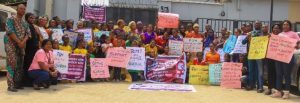
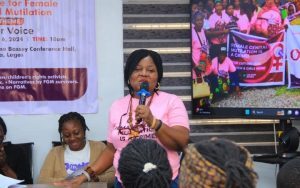
A non-governmental organisation, CEE-HOPE, in collaboration with Hearts 100, has held a day sensitisation workshop to oppose the barbaric act of Female Genital Mutilation (FGM) still in practice in some parts of the country, tagging the practice a human rights violation and a crime.
Female Genital Mutilation (FGM) is the cutting of the clitoris or burning the sensitive part with hot substance.
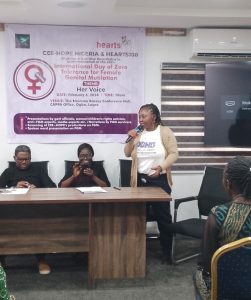
The workshop was a commemoration of the 2024 International Day of Zero Tolerance for Female Genital Mutilation marked every 6th February to create awareness and condemn the act also called female circumcision.
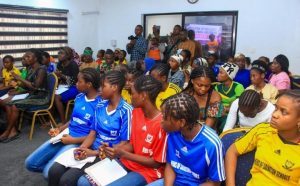
The 2024 edition of the United Nations Day has the theme “Her Voice, Her Future”. Participants were drawn from civil society groups, schools and the local communities.
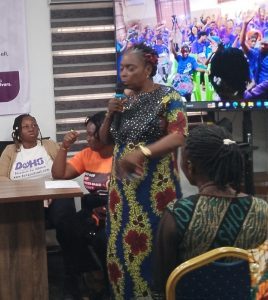
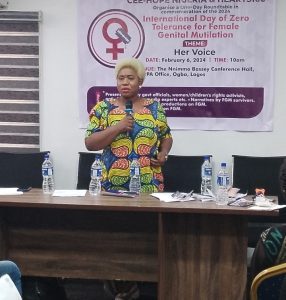
Talking to National Wire, Executive Director of CEE-HOPE, Betty Abah said FGM is a barbaric act that must be stopped by all means.
“It is worrisome to hear that Communities in the 21st century are still engaged in the barbaric act of FGM which has claimed several innocent lives,” she said.
Abah continued that, “FGM is not only a human rights violation, but it is also a crime against humanity.”
In her own way of proffering solution to the menace which is life threatening and dehumanising, Abah said, “There are legislations against the practice but enforcement must be heightened in order to see the end of the evil.”
The practice which is still in place in many African communities and even in some urban areas has been proven to cause harm to women in the form of prolonged labour, exposure to diseases, infections and lack of sexual pleasure for the circumcised at adulthood.
Anne Ruffer is the founder of Hearts100, who said more things must be done around sexual and gender based violence (SGBV).
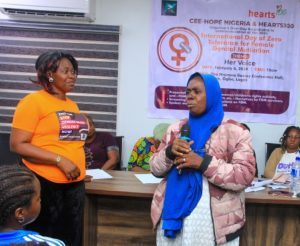
According to her, creating awareness about the issues, pressuring lawmakers to activate the relevant laws to protect women and girls are measures that can help in stopping the menace.
She however wants more to be done also for the protection of women threatened by SGBV via provision of shelter as well as economic empowerment via skills training, business grants and others so that they can be independent, rise above abuse and go on to maximise their potentials.
Bose Ironsi is the founder and Executive Director of Women’s Rights and Health Project (WRAHP), who at the event said, FGM endangers a woman’s reproductive ability.
“FGM threatens a woman’s reproductive ability and it should be stopped from taking place,” she said.
Survivors at the event also narrated their ordeals and vowed never to be involved in the practice.
For Fatima Daudu, she was cut at age 12 and the experience still lingers in her memory.
Daudu who is now a housewife and mother in her 30s, recalled with pain how her father made her go through the trauma of circumcision a second time within hours when the first cutting was not successful. She got her lap also sliced while struggling with those pinning her down.
Her mother who was opposed to the tradition had to walk out of the marriage before her father could carry out the tradition.
“I ran to my dad’s boss’ place. I told him to see what happened me. My dad’s boss then rushed me to a hospital. At the hospital, the health workers there stitched the cut on my lap and gave me drugs that eased the pain and controlled the bleeding,” Fatima recalled.
“My father’s boss told my dad that I was dead and he became scared. That was how he ran away to our native Borno State. Few days after, he died from the trauma of thinking that I was dead,” she said.
Fatima, in her 30s said she had to stop having children because all the four children came with delayed labour. “It was taking me two days in labour for each of my four children. So, I decided that I would not have any more children again,” she said, perhaps she didn’t know the prolonged labour was a result of earlier genital mutilation at the period.
For some, they just must preserve the tradition handed to them by their forebears, while for others, it is a thing of pride that their daughters have experienced it. Meanwhile for the vast majority who practice it, it is about the falsehood of stoping a woman from being promiscuous.
Another survivor and housewife, Folashade Onikoyi said her father told her the purpose of FGM was to prove her virgin to her husband on the conjugal night.
“My father said it will confirm that I am a virgin on the night that I would meet my husband and that people will be happy and there will be celebration.”
Another survivour and mother of three from Ebonyi State, south eastern Nigeria, Bridget Simon, said she was circumcised at age 12.
Her younger sister was not lucky, she died as a result of heavy bleeding. According to her, “she bled to death.”
A development expert and education consultant, Kingsley Obom-Egbulem, in his presentation, said “Those involved in FGM are telling God, the maker of humans that He made a mistake putting clitoris in a woman, hence their decision to correct the mistake by removing the clitoris.” He however condemned the act and enjoined the participants to report the crime to relevant agencies when such is about to happen.
Rights activist, Margaret Onah, at the event said, “FGM is still prevalent in Nigeria, especially in Osun State. Women in the village where ace musician, David Adeleke, popularly known as Davido hails from, vowed to continue with the practice.
“I am pleading with those who may know Davido to urge him to intervene by being a voice against FGM,” she pleaded.
Other speakers including Olalade Ajayi, Yinka Kenny and Anthonia Ojenagbon
took turn to condemn the act of FGM and admonished participants especially female students, social workers and mothers to reach out to relevant authorities to report such sadistic activities.
unanimously condemned the barbaric act.
Story by Dayo Emmanuel.