 National Wire About Nigerians, Nigerian Business and Other Stories


By Dayo Emmanuel
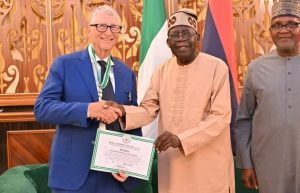
Global philanthropist and founder of the Gates Foundation, Mr. Bill Gates, was recently in Nigeria, where he addressed pressing issues around health technology, food production, and the future of philanthropy in Africa.
In a session with journalists in Lagos, Gates gave a candid account of his Foundation’s priorities, its 20-year plan, and the stark realities of dwindling international aid.
His visit highlights the urgency of reimagining Africa-led solutions, improving health systems, and securing sustainable food production.
A 20-Year Plan with Lasting Impact
Bill Gates’ recent announcement that the Gates Foundation will operate for the next 20 years of massive investment in Africa to the tune of $200bn raised questions about continuity and long-term commitment to the causes it supports.
But Gates, characteristically forward-looking, explained that the finite timeline is designed to increase the Foundation’s impact, not diminish it.
“By setting a 20-year lifetime, we can spend a lot more during those 20 years because we’re not saving for the years after that. So it’s a fantastic piece of news,” Gates said. He noted that the Foundation’s focus is on places where inequities are most extreme—countries where children under five still die in large numbers and where maternal mortality remains high.
Using examples from Asia, such as Vietnam and Indonesia, Gates illustrated how strong economic growth has enabled governments to assume full responsibility for healthcare programs previously funded by the Foundation. “The goal should be for all African countries to get to that middle-income status… where malaria no longer holds back economies,” he said, predicting a future where diseases like sickle cell and HIV could be eliminated with a single shot.
Navigating Security Challenges and Anti-Western Sentiment
Gates acknowledged the rise in anti-Western sentiments and insecurity in parts of Africa, including Nigeria, but he was surprisingly optimistic about the ability of health systems to function even under military or unstable regimes. “Even in countries where the army takes over, it doesn’t mean they stop caring about children dying,” he noted.
He cited Burkina Faso and Niger as examples where, despite political upheaval, primary health care systems remain functional. “In fact, Sokoto in Nigeria has a worse vaccination rate than Niger,” he observed. The insight is sobering, given that northern Nigeria has the lowest vaccination rates in Africa—lower even than Somalia, according to Gates.
Despite volatility, many governments continue to prioritize healthcare, albeit imperfectly. Gates emphasized that while regions like Central African Republic and South Sudan face near-total collapse, most countries are still keeping children’s health on the agenda.
Championing African-Led Innovation
When asked how the Foundation supports African-led solutions, Gates detailed their strategy: combining global research sophistication with local implementation. The Foundation’s philosophy is centered on making medical interventions affordable and scalable.
“We took the rotavirus vaccine from $60 to $2. We did the same for the pneumococcus vaccine. That’s how you save lives,” he stated. With their support, Nigeria recently rolled out the HPV vaccine, which now only requires a single dose to provide lifetime protection against cervical cancer—a shift driven by the Foundation’s research.
He emphasized that while some products like bed nets can be manufactured affordably in Africa, vaccines often require advanced facilities and rigorous quality control. “Some things can be made in Africa, and some can’t. You have to be smart about which is which,” Gates warned.
Immunization: Progress and Fatigue
Gates praised Nigeria’s success in eradicating wild polio virus but expressed concern about the resurgence of vaccine-preventable diseases due to faltering routine immunization coverage. “With polio, you have to get 90% coverage to eradicate it. We’re not there yet,” he said.
The Foundation, which contributes about 20% to immunization funding in Nigeria, remains deeply involved in both direct and supportive roles. Despite progress, six northern states, including Kano and Sokoto, are still battling with low immunization coverage.
“There is some fatigue,” Gates admitted, referring to the years of door-to-door campaigns required to maintain herd immunity. Yet he believes the battle is winnable with strong political will and continued investment. “When governors prioritize the campaigns and release the funds, we succeed.”
Coping with Dwindling Global Aid
A critical concern raised during the interaction was the cutback in global health aid—particularly from the United States and Europe. Gates did not mince words. “We’re already seeing a drop in funding. People don’t like to speak up about it, but this is terrible,” he said.
Contraceptive shortages have already begun in parts of northern Nigeria like Sokoto. The Foundation, despite its significant resources, cannot fill the void left by withdrawing governments. “All my money will be spent. If others increase, I still spend. If they disappear, I still spend. But my money is not extra money,” Gates stressed.
He warned that the drop in foreign aid would lead to increased maternal, HIV, and malaria deaths. “There is no alternate source that matches the scale of U.S. government funding,” he said, noting the ripple effect cuts to organizations like UNICEF and Gavi will have.
The Maternal Mortality Crisis in Nigeria
Addressing Nigeria’s staggering maternal mortality rate—accounting for 29% of all maternal deaths globally—Gates linked the crisis directly to underfunded healthcare. “Nigeria spends very, very little on health care. So I don’t know why you’d expect that number to go down,” he remarked.
The solution, he argued, lies in building up healthcare infrastructure that can handle complications like cesarean sections. “In northern Nigeria, about half of births happen at home,” he noted. This lack of access to skilled birth attendants significantly increases the risk of death for both mothers and babies.
He pointed to India’s model of driving institutional deliveries as an example Nigeria could follow. “It takes money. Without investment, you can’t expect results,” Gates added.
The Way Forward
Gates’ tone was clear: now is the time to double down, not retreat. He remains hopeful that within two decades, many African countries—including Nigeria—can move toward self-sustaining healthcare systems, if the right investments are made today.
From revolutionary vaccine delivery methods (like skin patches) to data-driven immunization campaigns, Gates continues to bet on innovation, government commitment, and local capacity building. But he is also deeply realistic. “There will be more deaths,” he warned bluntly, referring to the effects of aid cuts.
Still, his belief in the potential of Nigeria and Africa remains unwavering. “The next several years are very, very critical,” he said. Whether Nigeria rises to meet the moment will depend on choices made by its leaders—and whether the global community steps up to match the urgency.
Sidebar: Key Takeaways from Bill Gates’ Visit to Nigeria
Foundation Sunset: The Gates Foundation will operate for 20 more years, spending more aggressively to maximize impact.
Vaccine Innovation: Major success in driving down vaccine costs—from $60 to $2.
Routine Immunization: Northern Nigeria still has the lowest rates in Africa; urgent need to improve.
Maternal Health: 29% of global maternal deaths occur in Nigeria; institutional delivery must be prioritized.
Foreign Aid Cuts: Sharp reductions in global health aid are already being felt; no adequate replacement exists.
Local Manufacturing: Strategic support for manufacturing bed nets and select vaccines in Africa.