 National Wire About Nigerians, Nigerian Business and Other Stories


The post-COVID recovery years were a defining period for businesses in Nigeria. As companies struggled to regain balance, inflation soared, foreign exchange became unstable, and the Naira’s sharp decline pushed production costs higher. Consumers felt the impact as prices of manufactured goods surged. Amid these headwinds, Nestlé Nigeria Plc faced similar pressures but proved its resilience. In the years 2022, 2023 and 2024, the company navigated economic volatility with strategic focus, sustaining operations, fulfilling obligations, and reaffirming its leadership in Nigeria’s manufacturing sector. DAYO EMMANUEL, News Editor, National Wire reports how Nestlé Nigeria maintained relevance in its sector within the recovery years.
After the COVID-19 pandemic, Nigeria’s economic landscape remained turbulent, marked by foreign exchange instability, inflationary pressures, energy cost spikes, and weakening consumer purchasing power. The years after the pandemic became years to restart businesses and ideas. The world adopted new strategies often referred to as ‘new normal’, where new survival strategies became the new standards.
Meanwhile, amid these challenges, Nestlé Nigeria Plc has continued to demonstrate remarkable resilience — maintaining its corporate relevance, keeping up with tax obligations, increasing revenues, and sustaining a visible footprint in corporate social responsibility (CSR). No doubt, the sound foundation the organisation was built upon was able to withstand the storms of the evil days.
Examining Nestlé Nigeria’s financial reports from 2022 to 2024 reveals a story of strategic balance between profitability pressures and social impact, a tale of both perseverance and areas demanding reflection.
Between 2022 and 2024, Nestlé Nigeria’s revenue grew impressively, defying the economic headwinds that slowed many Nigerian manufacturing companies.
In 2022, the company reported total revenue of ₦446.82 billion, which climbed to ₦547.12 billion in 2023 — a year marked by rising inflation and the lingering effects of Naira depreciation. Inflation in Nigeria in the year under review shocked the economy as Naira kept racing after the US dollar which was responsible for high cost of production and the eventual his cost of goods and services.
However, the momentum continued in 2024, when the company’s revenue reached a remarkable ₦958.81 billion, more than double its 2022 base.
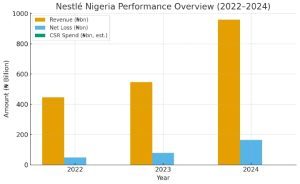
This upward trajectory reflects the company’s strategic pricing adjustments, market penetration strength, and sustained consumer loyalty despite reduced disposable incomes across households. Nestlé’s brand power in products like Milo, Maggi, and Golden Morn clearly provided a cushion against declining purchasing capacity in Nigeria’s food and beverage market. Of course the administrative prowess was brought to play and the revenue despite the inflation didn’t deter the organisation that must continue it’s legacy.
However, while revenue increased substantially, it came at a cost — inflationary pressure on inputs, higher logistics costs, and energy expenditure significantly affected profit margins. This is very obvious in the books of the company with so much lessons to learn.
The company’s results from operating activities followed the same positive trend, climbing from ₦87.47 billion in 2022 to ₦123.79 billion in 2023, and further to ₦167.88 billion in 2024. This growth shows that Nestlé managed its operations efficiently, leveraging economies of scale and maintaining productivity in an environment where many industries struggled to stay afloat.
Yet, this achievement was accompanied by a notable increase in loss before income tax, which rose sharply from ₦71.11 billion in 2022 to ₦104.03 billion in 2023, and a further leap to ₦221.59 billion in 2024.
This dual reality — growing revenue alongside growing losses — paints a complex picture. On one hand, Nestlé has sustained market leadership and operational momentum. On the other, the company’s rising pre-tax losses raise important questions about cost structure, foreign exchange exposure, and debt servicing obligations, particularly in an economy where imported inputs remain heavily affected by exchange rate fluctuations.
Despite the recorded losses, Nestlé Nigeria remained committed to fulfilling its tax obligations, a commendable sign of corporate citizenship. Over the three years under review, the company reported consistent income tax credits: ₦22.14 billion in 2022, ₦24.55 billion in 2023, and ₦56.99 billion in 2024.
While these tax credits partly reflect adjustments due to losses and deferred tax entries, the figures affirm Nestlé’s compliance with fiscal responsibilities. In an environment where tax evasion is a common temptation for loss-declaring companies, Nestlé’s sustained reporting and transparency are praiseworthy. This is also a standard the organisation has established from time immemorial.
The company’s net losses are another area that invites attention. Nestlé Nigeria recorded a loss for the year of ₦48.97 billion in 2022, ₦79.47 billion in 2023, and a staggering ₦164.60 billion in 2024.
While the losses can be contextualized within the broader national economic challenges — especially inflation, energy crises, and currency volatility — the trend nonetheless calls for introspection. A tripling of losses within three years suggests that the cost of doing business is rising faster than the company’s capacity to absorb shocks through operational efficiencies. No company can exist in isolation without feeling the impact of the environment in which it operates, Nestlé Nigeria can only weather the storm effectively to keep head above the water in a period of national economic uncertainty know that it’s publics are also praying to survive.
Constructively, Nestlé may need to re-evaluate its cost optimisation strategies, local sourcing options, and energy diversification to mitigate dependence on volatile import-linked inputs. In addition, improving digitalisation in its supply chain and distribution network could help control cost leakages. Local sourcing of materials may just be the best options in order to minimise the cost of production.
Still, maintaining a stable share capital of ₦396.33 million over the three-year period reflects consistent shareholder confidence in the long-term stability of the company.
Beyond the balance sheets, Nestlé Nigeria’s story over the past three years is equally defined by its unwavering commitment to corporate social responsibility. Even in periods of financial strain, the company demonstrated that profitability is not the sole measure of relevance — impact is.
The company’s Nestlé Community Water Projects, School Projects, and Scholarship Scheme collectively tell a story of sustained investment in human and community development. Spending in this category, which dipped slightly from ₦34.88 million in 2022 to ₦27.41 million in 2023, rebounded impressively in 2024 to ₦66.47 million, almost double the 2022 figure. This rebound indicates renewed vigor in addressing community needs, especially access to clean water and education. This the company did as it didn’t mind the years of losses.
However, the fluctuation also reveals the impact of cost pressures on social investments. Companies like Nestlé must ensure that CSR budgets, though flexible, are not the first casualty in times of economic difficulty.
Nestlé’s “For Healthier Kids” initiative remains one of its flagship programs, reflecting the company’s strong alignment with the United Nations Sustainable Development Goals (SDGs) on child health and nutrition.
The firm spent ₦54.21 million on the project in 2022, rising to ₦67.49 million in 2023, but the 2024 figure fell dramatically to ₦10.18 million. This sharp drop — over 80% — raises concerns about the continuity of an initiative that directly impacts child nutrition and education in a country where child malnutrition remains a national challenge.
While cost control might justify the dip, Nestlé could consider restructuring such programs to attract public-private partnerships or donor collaborations to sustain their reach and impact.
The Rural Women Empowerment Project remains another testament to Nestlé’s social commitment. The company spent ₦25.99 million in 2022 and ₦11.89 million in 2023, before improving to ₦13.80 million in 2024.
Although the rebound in 2024 is encouraging, the program’s overall reduction from 2022 levels suggests room for reinforcement. In a post-pandemic economy where rural women face increased livelihood struggles, consistent empowerment initiatives are vital. Nestlé’s renewed attention in 2024 shows potential, but more strategic scaling — possibly in collaboration with local cooperatives — would deepen impact.
In partnership with the Nigerian Economic Summit Group (NESG), Nestlé’s annual support remained steady at ₦10 million in both 2022 and 2023, increasing modestly to ₦15 million in 2024. This demonstrates a continuing commitment to national dialogue on policy and economic development.
Similarly, the company’s Technical Training Centers (TTCs) — designed to build technical capacity in Nigerian youth — reflect an impressive growth in investment. From ₦46.87 million in 2022, funding for TTCs more than tripled to ₦156.15 million in 2023 and further increased to ₦176.64 million in 2024.
This exponential growth is one of the most commendable highlights of Nestlé’s CSR portfolio. In a nation battling youth unemployment and skill mismatch, such interventions contribute directly to workforce readiness and industrial development. Nestlé deserves commendation for prioritizing education and skills — a long-term investment in Nigeria’s human capital.
Under Nestlé Cares, the company’s product donations — including orphanage outreach — stood at ₦37.55 million in 2022, ₦43.63 million in 2023, but dropped significantly to ₦5.13 million in 2024.
The 2024 decline, though possibly tied to cost rationalization, weakens one of the brand’s most emotionally resonant connections with communities. Nestlé’s strength has always been in building trust, and product donations often serve as a grassroots channel for that engagement. A more consistent approach could sustain goodwill, especially during times of economic hardship.
Nestlé Nigeria’s three-year journey from 2022 to 2024 encapsulates the story of a multinational that has navigated turbulence with grit, maintaining relevance despite mounting economic pressures.
The data show a company that continues to generate revenue, fulfill tax obligations, and uphold CSR commitments even while facing profitability challenges. This balancing act is no small feat.
Yet, constructive criticism is warranted: the rising losses demand tighter cost controls, local supply chain strengthening, and renewed attention to high-impact social programs like child nutrition and rural empowerment.
As Nigeria’s economy seeks recovery pathways, Nestlé’s performance offers both lessons and inspiration — proof that corporate endurance, when mixed with responsibility, can still thrive amid storms.