 National Wire About Nigerians, Nigerian Business and Other Stories


For many years, the organised labour unions in Nigeria have been advocating for a new minimum wage structure to reflect the nation’s economic realities. Despite these efforts, domestic workers, who number around four million according to a study, remain marginalised and unprotected within Nigeria’s informal sector. These workers, often facing severe abuses and underage exploitation, lack the rights and recognition enjoyed by their counterparts in other African countries. Activists including CEE-HOPE Nigeria and other civil society organisations are rallying to unionize domestic workers, pushing for legislative reforms to safeguard their rights and improve their working conditions. DAYO EMMANUEL here reports.
In recent times, the Nigerian Labour Congress (NLC) and its sister organisation, the Trade Union Congress (TUC), have continued to engage the Federal Government of Nigeria on a new minimum wage structure in light of current economic realities.
According to statista.com, the Nigerian workforce comprises about 60 million workers, which is slightly above the population of Italy, serving over 200 million Nigerians.
Domestic workers are not included in this figure as they operate in an informal and unregulated environment.
The DewDrop Foundation, a civil society organisation, estimates that there are about four million domestic workers in Nigeria, which is approximately six percent of the regular workforce. These individuals provide various services, including housemaid services, cooking, stewarding, caregiving, nannying, gardening, cleaning, and messenger services. They are often the breadwinners in their families.
Many of these individuals, many of whom are under-aged, are not always fortunate with their employers and face numerous professional hazards, including humiliation, dehumanisation, molestation, hunger, sexual harassment, rape, and deprivation from basic education.
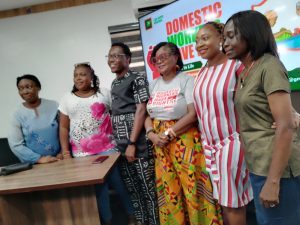
Recently, the Centre for Children’s Health Education, Orientation and Protection (CEE-HOPE), Nigeria, in collaboration with Rosa Luxemburg Stiftung, rallied other human rights groups to champion the rights of domestic workers in Nigeria and campaign for their unionisation.
The event, held in Lagos, gathered rights activists, social workers, and journalists to discuss the urgent need for recognising and protecting domestic workers’ rights.
Betty Abah, Executive Director of CEE-HOPE Nigeria, highlighted the severe oppression and invisibility faced by domestic workers in Nigeria. “Domestic workers in Nigeria are not just oppressed but are invisible,“ she emphasised.
Abah compared Nigeria with some African countries where domestic workers are unionised, saying, “Unlike countries like Kenya, Uganda, and South Africa, domestic workers have unions and know their rights but in Nigeria, domestic workers suffer various abuses and lack awareness of their rights.”
According to statistics from the International Labour Organisation (ILO), Abah stated, “Globally, there are 75.6 million domestic workers, 76.2 percent of whom are women. Additionally, 152 million children, including 64 million girls and 88 million boys, are involved in child labor worldwide. Although domestic workers provide essential services, they rarely have access to rights and protections. They work in isolation under harsh, unregulated conditions and are often underpaid, facing various forms of abuse,” Abah said.
She believes that unionising domestic workers could help safeguard their rights and address issues of underage labor in the sector. Despite Nigeria’s ratification of ILO Convention 189 in 2011, which recognises the rights of domestic workers, abuses continue largely because domestic workers have not been captured in the database of the regular workforce despite their important role in the economic ecosystem.
Human rights activist, Hassan Soweto, called for a legislative review and advocacy.
“We need to study current labor laws in Nigeria and learn from other African countries where domestic workers have union protections. This will help us to intervene effectively and propose new legislation,” Soweto suggested.
According to Soweto, “Domestic work is going to continue to exist and would be carried out by people, it is the lowest scale of human endeavour. Even those not domestic workers like women in patriarchal relationships have found themselves in this situation where they find it difficult to aspire, then these individuals must be protected.”
In South Africa, where domestic workers operate in a structured work environment, they still struggle to maintain a decent work climate. According to an online report from businesstech.co.za, a recent Quarterly Labour Force Survey (QLFS) in South Africa reveals that the country’s unemployment rate saw a slight uptick, rising to 32.9% from 32.1%, resulting in the loss of around 7,000 domestic worker jobs.
The report continued that as economic tension mounts in South Africa, leaving households under increased pressure due to rising living costs, domestic workers at the lowest ebb of the employment structure are often among the first to be ‘let go’.
In South Africa, domestic workers make up the largest percentage of vulnerable occupations (28%) but are still captured in the national labor force, making their data visible and their plights addressable, unlike in countries like Nigeria where domestic workers still operate in an informal workspace.
Ronke Oyelakin, the Lagos State Coordinator of Child Protection Network and a representative from Bimbo Odukoya Foundation, argued against engaging under-aged domestic workers, stating, “Child labour, especially in domestic work, is exploitative and illegal. We must ensure that every child has equal opportunities and is protected from abuse.”
She also explained, “We have the Child Rights Act in Lagos State which makes it clear that every child, irrespective of family background, should be given equal rights.”
Oyelakin further noted, “The International Labour Organisation estimates that there are up to 15 million workers under age 14 in Nigeria, many of whom are house girls. Imagine a girl used as a house girl is at risk of different exploitation. She could be abused sexually.”
Funmi Ajayi, who experienced the plight of a domestic worker in Jos, Plateau State, northern Nigeria while living with her uncle as a little girl, called for proactive measures to ensure the unionisation of all domestic workers in Nigeria, emphasising the need for on-the-ground advocacy. Child labor and exploitation are common within family circles where children of the less privileged are exploited under the guise of receiving training assistance.
One Nigerian who suffered in the hands of relatives as an under-aged domestic worker is Rose Fruitful Edeh.
Edeh lost her father when she was barely two years old, and her widowed mother struggled to care for 13 children. “I was barely two when my father died, and my mother had a big task of taking care of 13 children then in Benue State where we come from,” she said.
Edeh found herself in Lagos, where she faced harsh treatment far from her mother’s care. By her late teens, she had served in four households in different states with harrowing experiences.
There are benevolent employers as well who adopt their domestic workers into their families.
Mrs. Oluwakemi Campbell, a Lagos-based Travel Consultant, suggested setting a minimum age for domestic workers in Nigeria.
“What I would suggest is that there needs to be a minimum age for domestic workers as done in civilized countries,” she said.
Campbell also suggested enforcing a minimum wage to stop the exploitation of domestic workers.
“A minimum wage can only be enforced if all domestic servants are doing it for money. I have had three domestic workers in my life, and only one was in it for money; the other two just wanted education and a better life, and we are doing our best in that regard, God helping us,” she said.
She also recommended minimum conditions of work, stating, “There should be a minimum condition of work. However, the children should not be maltreated, and they should be given a better quality of life as promised to their parents.”
According to Campbell, she and her husband are sponsoring one of their former domestic workers, whom they adopted into their family, to study for a degree at a federal university.
For Oluwatoyin Jiboku, who recently retired as a psychiatric nurse from the Neuropsychiatric Hospital, Aro, Abeokuta, Ogun State, her experience with domestic workers has not been palatable due to the activities of middlemen.
According to Jiboku, “My experience with domestic workers has not been so good. This is largely because their rights have been trampled on, and they are left at the mercy of the middlemen who source jobs for them. Sometimes they don’t get to remit their remuneration, or such remuneration is often squandered by the middlemen.”
She recalled a positive experience among several bitter ones. “The only good experience is about a lady who came to me in her twenties and needed money for stability. She was up to the task and collected her wages through a bank account I opened for her. She knew her job description as domestic and helped out with sales in my shop when I was at work and the children in school. She was a good manager, and I miss her up till today.
“Having a minimum wage will help them from being exploited, and conditions of work will help them prepare ahead of the task,” she concluded.
Emeka John, a publisher who has engaged several domestic workers for his family, recognises the need to regulate the domestic work sector.
“First, it’s important to understand that domestic workers fall within the informal work space. It is informal because in the Nigerian context, it is not yet captured into an organised service system. So, it is the duty of the Nigeria Labour Congress or any organisation to call for capturing into a recognised workforce.
“It is within the right of domestic staff workers to be so recognised as important service providers to homes so that they are protected from slavery, and those who hire them too are protected,” he advised.
John believes domestic workers should enjoy the minimum wage because of the important task they handle for homes. “Personally, I have had domestic staff, and the first thing I do is try to pay them the national minimum wage as a base. Second is that I make them sign agreements once they come into my home, and I try to keep them engaged by sending them for skill acquisition during the period when my children will be at school. I have managed them through this method such that by the time they are leaving my home, they are empowered with a skill,” he said.
A former banker, Mrs. Sola Abolaji, who has extensive experience with domestic workers, also supports regulation in the domestic workspace.
“Going by the way domestic workers have been treated and are still being treated by some hosts, I think there is a need for regulation. This is a two-way argument, but the support for better remuneration and treatment of the domestic workers supersedes the other,” she said.
She further noted, “The extortion by the agents that bring them from the comfort of their families has contributed negatively and rather injuriously to the obnoxious behavior of this set of people. Setting up a Union and a unified remuneration would go a long way to sanitise the system.