 National Wire About Nigerians, Nigerian Business and Other Stories


By Dayo Emmanuel
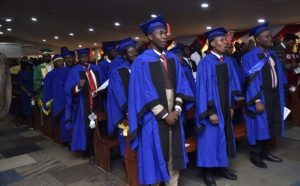
Anglican Bishop of Ilesha Diocese, the Rt. Rev. (Prof) Dapo Asaju, in a fiery and wide-ranging lecture at the 34th and 35th Combined Convocation of the West Africa Theological Seminary (WATS), Lagos, on Saturday, November 29, called theology “the queen of every profession” and urging graduating ministers to defend biblical truth amid what he described as growing corruption within global Christianity.
Speaking as guest lecturer at the seminary founded by American missionaries Professor (Rev) Gary S. Maxey and his wife Rev. Emma Lou Maxey in the early 80s, the former Vice-Chancellor of Ajayi Crowther University, Oyo, said all modern professions including medicine, law, governance, engineering, science, and even artificial intelligence are rooted in theology.
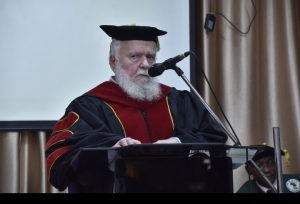
“Theology produced medicine, produced accountants. Even the structure of governance came from Isaiah 33:22—God as King, (Lawgiver), and Judge,” he told the assembled graduates and guests.
“What they have given you here is raw material. It is what you make of it,” he charged the graduating graduating students.
Warning Against ‘Revisionist Theologians’
Asaju warned that the church is under infiltration by people he described as agents of darkness who have risen through church ranks around the world. According to him, some of these individuals now occupy high ecclesiastical offices including among General Overseers and bishops and are promoting teachings contrary to Scripture.
“The Kingdom of the devil has entered the church. They have grown through the ranks and become General Overseers,” he declared. “Whoever you are, the Bible is your constitution. You cannot be wiser than the Holy Bible. One thousand theologians cannot negate one verse.”
He cautioned graduates to resist what he called “revisionist theologians” attempting to rewrite Scripture to fit human rationalism, modern ideologies, or Western liberalism. “Don’t let your brain get into your heart. We walk by faith and not by sight,” he said, insisting that human science and experimentation must not override divine revelation.
‘Your Training Is Enlistment Into God’s Army’
The Anglican Bishop said theological education is not an academic trophy but spiritual enlistment into service. Drawing from Solomon and Paul, he emphasised that knowledge should lead to impact, not pride.
“Your training here is to enlist in an army. It’s not a degree for you to go around showing what you have acquired,” he said. “Too much academics is wilderness of the mind. What is the conclusion of the matter? Fear God, for this is the whole duty of man.”
Using Apostle Paul as an example, he urged graduates to let their theological training create transformation in clergy work, society, and the Church. “The wisdom and the theological erudition of Paul made a difference. You have studied under Gamaliel here, it makes a difference,” he said.
He also urged the graduates to continue lifelong learning under what he described as the “University of the Holy Spirit,” assuring them that the Holy Spirit will guide them into ministry decisions and interpretations of Scripture.
Referencing Jude, Sodom, and Contemporary Moral Debates
The cleric, Asaju anchored much of his lecture on the New Testament book of Jude, warning that the same errors Jude condemned—false teachings, ungodliness, and distortions of grace—are resurfacing today.
He criticised recent trends in the global Anglican Communion, including the acceptance of homosexual clergy in some Western provinces. “Sodom and Gomorrah happened over 5,000 years ago. This homosexual nonsense they are discussing today is not new. Did God call a theological conference to debate it?” he asked.
Quoting Old Testament penalties for homosexuality, bestiality, and incest, he maintained that the Bible’s moral laws remain unchanged. “God has not changed. What God hates is what we are celebrating,” he lamented.
He expressed concern that some Western theological colleges, bishops, and institutions are advancing teachings he described as “rubbish,” urging WATS graduates to “recover the church” and defend biblical truth. “This seminary stands for truth and holiness,” he affirmed.
A Call to Simplicity, Humility, and Christ-like Ministry
The lecturer then shifted to Christ’s model of ministry, stressing humility, sacrifice, and a life of service over pursuit of titles or materialism.
“You cannot be more Christian than Jesus. Perish title, perish position, perish materialism,” he said. “Jesus was a simple person; He went about doing good. He healed, He liberated. The Son of Man had nowhere to lay His head.”
Drawing from 1 Corinthians 13, he emphasised that spiritual gifts alone do not define a Christian; rather, the fruits of the Spirit—love, patience, humility, kindness—are the true marks of ministry. “All the gifts of Pentecostalism cannot match one fruit of the Spirit,” he remarked.
To illustrate the value of practical ministry, he shared a story of a professor of mechanical engineering stranded on the road and rescued by an illiterate mechanic. “Who is the professor? The man who got the job done,” he said. “Your theology makes sense only when it is practical.”
‘You Will Be Distributors of Miracles’
Asaju pronounced prophetic blessings on the graduating class, declaring that God will empower them for healing and deliverance. “Your hand will be the finger of God. You will move mountains, you will preach the gospel, you will heal the sick, cast out demons, raise the dead,” he prayed.
He further charged them to embrace the manifestos of Jesus (as outlined in Isaiah 61 and Luke 4) and Apostle Paul—to liberate the oppressed, bring justice, comfort the brokenhearted, and transform society.
Critique of Nigeria’s Political and Religious Leadership
The lecture also touched extensively on national issues, including insecurity, Christian persecution, and political leadership.
Bishop Asaju criticized Nigerian church leaders for failing to speak boldly against government actions, especially concerning insecurity in the north and middle belt. He argued that many of Nigeria’s current political and religious figures lack courage and vision.
“We have no leaders anymore—whether Igbo, Yoruba, or Hausa. In those days we could talk of Azikiwe, Awolowo, Sardauna, Kwame Nkrumah, Julius Nyerere, Jomo Kenyatta,” he said. “Today, we need to raise leaders. We don’t have leaders anymore.”
He recounted challenging former President Muhammadu Buhari and lamented that many church leaders refused to confront injustices. He described Nigeria’s current political situation—including the imposition of a Muslim-Muslim ticket—as unfair, arguing that Christians are suffering targeted attacks.
Expressing frustration, he said: “Our brothers are being slaughtered in the north and middle belt. Villages are taken over. Those carrying AK-47 walk freely while others are arrested. When injustice persists, God will step in and rearrange things.”
‘May You Be Radicals Like Jesus’
Calling for bold Christian activism, Asaju prayed that graduates would be fearless defenders of righteousness.
“We need radicals. May you not be Christian gentlemen. May you be radicals like Jesus. May you take koboko and drive those selling in the temple,” he urged.
He challenged them not to commercialize prophecy, tithe, or offerings, but to embrace sacrifice and ethical leadership. “May you not live at the expense of the congregation,” he added.
Africa’s Legacy and Christianity’s Global Decline
The bishop highlighted Africa’s historic role in defending the Christian faith during early church controversies. He lamented the decline of Christianity across Europe and parts of Asia Minor, where Islam has gained ground and once-Christian cathedrals have become mosques.
He referenced former Libyan leader Muammar Gaddafi’s claim that Islam would take over Europe without firing a bullet, warning that similar patterns may unfold without strategic Christian response. “We have no agenda,” he said. “They are taking over territories and rights. You have work to do.”
A Challenge: Certify the Truly Called
Asaju concluded by urging theological institutions—including WATS—to help the church discern genuine calling among ministers. With the rise of false prophets and untrained pastors, he said, the church must prioritise character, calling, and competence.
“These are the challenges: to certify who is genuinely called,” he said. “Theological education is training people to serve God. God is the one you are serving, not man.”
Charge to the Graduating Students
The bishop’s final charge emphasized courage, biblical fidelity, humility, and societal transformation.
“Combine the manifestos of Jesus and Paul, and you have a good manifesto to work with,” he told graduates. “Go and make a difference in your society.”
Asaju closed his convocation lecture with an urgent, pastoral charge that fused historical perspective with a stark diagnosis of contemporary ills, and a rallying call to the new generation of church leaders. He acknowledged with measured pride that Nigerian churches have flourished abroad — “God is prospering them” — but warned that outward success must be matched by inward transformation on home soil. The problem, he argued, is not presence but potency: many churches are geographically global, he said, “but the context and content is still the same thing” — implying a need for theology and mission that can cross cultural boundaries both ways.
Drawing on the legacy of the Church Missionary Society, Asaju reminded his audience that missionary zeal once combined spiritual purpose with social reform. He recalled the Society’s founding in 1779 by eight Oxford graduates and men like William Wilberforce, who paired gospel proclamation with a campaign to end slavery. That combination of moral courage and evangelical commitment, he said, produced enduring institutions of education, health care and public good across continents. “Few of you in this set will do greater work than these people,” he told the graduates, urging them to match history’s missionary imagination with contemporary urgency: “You must now take the Gospel back and reclaim the West, reclaim America.”
Yet his tone shifted quickly to the perils he sees within and around the church. Culture, he warned, must never be allowed to supplant the gospel: “When culture and the gospel clash, culture must bow to the gospel.” Citing disturbing reports of occult practices and even allegations of human sacrifice by a pastor, he begged ministers to purge their pulpits of “strange altars” and syncretistic practices that dishonour Christian witness. More alarming, he said, is the erosion of spiritual guardianship — the disappearance of watchmen who, like Ezekiel’s prophetic watchman, blow the trumpet against evil. “We don’t have watchmen anymore,” he said bluntly. “Blow the trumpet when you see evil and sin… If you don’t, the blood will be required of you.”
Asaju mapped a geopolitical and cultural landscape of threats. Secularism in the West, he said, and the rise of state atheism in places like China, stand alongside materialism in Africa that has been fuelled by prosperity preaching. He named the rise of secret societies made visible — startlingly noting that ògbóni “now has a website” — and the recruitment of young people into occult paths and internet-era criminality. He painted a picture of a church that is politically disempowered, its leaders compromised by patronage, its voice muted in assemblies where Christian representatives fall silent after inducements. The proliferation of denominations, he lamented, has produced disunity at precisely the moment when the body of Christ needs coherence and courage.
Most sharply he denounced prosperity theology. Graduands, he urged, should preach “the theology that can save” — repentance, judgment, heaven and hell — rather than messages that reduce faith to financial formulae. He warned that doctrinal laxity opens the door to social ills: young men drifting into internet fraud, the inroads of homosexuality into seminaries through foreign funding, and the planting of tares among the wheat a deliberate subversion that may produce leaders who will change rules and “destroy Christianity.”
But Asaju did not leave his listeners in despair. His concluding appeal was a blueprint for renewal rooted in family, power and prayer. He called for a revival of the family church — daily gatherings where parents lead children in devotion — as the formative engine that once produced spiritually resilient communities. He insisted that Christianity must demonstrate the power of God: miracles and signs, he argued, are not gimmicks but authentications of a living faith. “If you don’t believe me for my theology,” he reminded them, “believe me for the sake of the signs you see that I perform.” Quoting Paul, he rejected merely human philosophies in favour of ministry “in the demonstration of the power of God.”
To the graduates he issued a personal, prophetic injunction: seek practical ministry training “after the order of Christ,” and pray for the unction that anointed apostles, prophets and reformers. He named Martin Luther and John Calvin alongside the missionary pioneers, asking God to place their wisdom, courage and apologetic zeal upon the next generation. “Give me wisdom,” he prayed, “make me an apologist and defender of the Christian faith. Let me have a full proof of my training here.”
His final words were both a benediction and a challenge: the historic institutions and sacrificial pioneers who spread the gospel across continents had left a legacy that demanded stewardship. If the church today is to survive — and to reclaim lost ground — it must recover prophetic courage, doctrinal clarity, family-shaped discipleship and the experiential power of God. In Professor Asaju’s view, the task is urgent, the tools are known, and the responsibility rests with a generation now stepping into leadership.