 National Wire About Nigerians, Nigerian Business and Other Stories


A non-governmental organization, Stakeholders Alliance for Corporate Accountability (SACA),has ended a three day training on atmospheric gas testing principles and procedures, and the possible effects of hazardous gases on human health and lives.
National Wire reports that Field Officers and management staff of the National Oil Spill Detection and Response agency(NOSDRA), the Bayelsa state Ministry of Environment and SACA staff participated in the training.
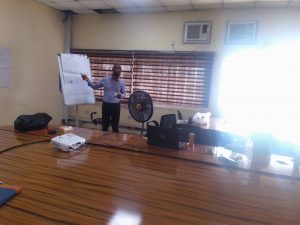
National Wire gathere that the training was conducted to enhance the capacity of the regulatory bodies to ensure that oil and gas industry operates in a safe and healthy manner to safeguard field regulatory staff, operator’s agents/staff as well as communities from hazardous gas during joint investigation visits(JIV), equipment repairs, remediation of oil polluted sites, independent investigation and sewer maintenance.
Speaking with National Wire shortly after the event, the Executive Director of SACA, Mr Kingsley Ozegbe described the training as apt, adding that the essence of the programme was to change the regulators attitude and practice to safety and inform the general public about the dangers inherent in some of the gases that are released into the environment from oil spills, gas leaks and gas flares.
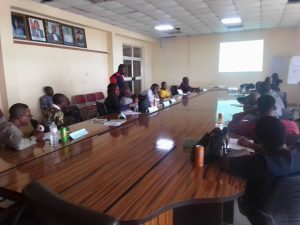
Ozegbe stated that even some gases considered not harmful could become hazardous to human life and the Environment when they react with other gases in the air in the presence of sun rays.
He said: “Today, through this training participants have also learnt that even those gases which ordinarily could be considered non hazardous too could pose hazards. We therefore call on the Government, oil companies, refineries and all operators in both the public and private sectors to be cautious in their handling and regulating of the oil and gas sector. The citizens must play their part in reducing the emission of the dangerous gas”.
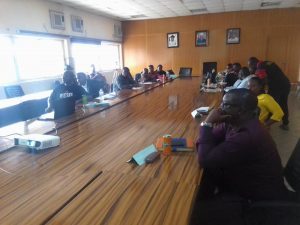
“We call on the State and Federal Governments to support the Ministries of Environment and NOSDRA to acquire gas monitoring devices and Personal Protective Equipment in line with standard practice to minimize both short-term and long-term effects that arises to relatively high exposure.
“Already SACA has acquired their own air monitoring devices which would help them monitor the air quality and gases in our environment. The equipment includes the Aeroqual Series 500 gas monitor and the sensors for different gases, including ozone, methane, volatile organic compounds (VOC) and carbon monoxide. We’ve also acquired the PM2.5 and PM10 sensor”, he said.

National Wire further reports that the training which was funded by Misean Cara of Ireland and the St.Patrick Missionary Society was held at the Bayelsa state Ministry of Environment with 16 participants in attendance.
Meanwhile the instructor at the programme,Mr Ukekwe Charles has praised the efforts of SACA and highlighted that it strengthened organizational capacity to know some combustion, health and environmental hazards posed by some of the gases, noting that if not properly handled by operators and regulators in the oil and gas industries, and municipal administrators, some of these gases may pose significant threat to both human life and the entire ecosystem.

He identified one of such dangerous gases as hydrogen sulfide,saying it is heavier than air and therefore tend to concentrate in lower levels and spaces like sewers.
He said: ‘Hydrogen sulfide can be found in stale sewers when disturbed and can be lethal in very high concentrations.
“Though we need oxygen as humans to stay alive, but we must also know that too much of oxygen in the environment also poses risk and that can create an explosive environment. However, too little oxygen is also bad because it lead to asphyxiation”.
He reemphasized that different gas monitors can draw and test the air by natural diffusion, using an inbuilt aspirator or through a physical pump depending on the design, adding that the agencies should also test the atmospheres whenever they go for inspections or investigation of oil spills so as to protect themselves from breathing harmful gases.
He enjoined operators, regulators anf municipal administrators to always have a dedicated person whose job will be to continuously monitor the atmosphere while work in ongoing, adding that even when the concentration of dangerous gases in an environment is below the threshold limits, workers should still plan to spend very limited time in such potentially hazardous environments, or take brakes as often as possible.