 National Wire About Nigerians, Nigerian Business and Other Stories


Report by Dayo Emmanuel
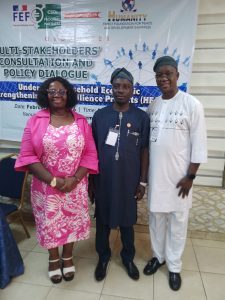
Key actors in government, civil society and the development space converged on NECA House, Ikeja, Lagos, for a high-level Stakeholders’ Consultation and Policy Dialogue on Women’s Economic Empowerment and Financial Inclusion under the Household Economic Strengthening and Resilience (HEAR) project, with a strong call for improved access to finance, financial literacy and supportive policy frameworks to help women build sustainable wealth.
The dialogue, convened by the Humanity Family Foundation for Peace and Development (HUFFPED), centred on the theme of deepening women’s economic participation through structured empowerment, access to soft loans and strategic partnerships. The HEAR project, funded by the French Embassy, was presented as a model for strengthening household income resilience, particularly among vulnerable women and adolescent girls.
Speaking at the event, the Executive Director of HUFFPED, Mr. Henry Adenigba, said the HEAR initiative has already made significant impact by lifting the economic capacity of 500 women and adolescent girls through Income Generating Activities (IGA).
“We are here today to do a policy dialogue on the issue we call HEAR. What do we mean by HEAR? Household Economic and Resilience. This is a project funded by the French Embassy, and they give us a whole year’s activity to perform,” Adenigba said.
He described the intervention as both strategic and gender-focused.
“It is a feminist project that is by the French Embassy for us to take care of women, both adults and young adolescents,” he stated.
According to him, the outcomes recorded so far demonstrate the viability of structured empowerment backed by monitoring and financial inclusion strategies.
“The result so far has been great, and we thank God we have been able to do what we’re meant to do. And about 500 women have been empowered, including adult women and adolescent girls, apart from helping with vocations, they are actually being taken care of. We are doing Income Generating Activities (IGA) for adolescent girls who are done with school and have nothing doing presently,” he explained.
Detailing the specific trades beneficiaries ventured into, Adenigba said: “Some went into auto gele making. Some went into makeup. Some went into bead making, some went into adire making, some into confectionary and all that. So they are being empowered to be able to take off with the small grant that we gave them to start on their own.”
He further clarified the distribution of beneficiaries and the hands-on support provided.
“There are 243 among the 500 women and others are the adolescent girls who are given the income generating activities, IGA.
“We follow them up after empowering them on their trade. Some are trading on charcoal, which they only need N15,000 to start and then they start having good money as a return on their investment. Some have been trained to be Seamstresses and they have no money for machines. We have given them some money for machines. Some only need to upgrade with the stoning machines, they already have been given what they need to acquire the stoning machine.
“The adolescent girls have been put into vocations in five Local Government Areas of Kosofe, Shomolu, Lagos Island, Surulere, Ikorodu north,” he said.
The consultation moved beyond reporting achievements to interrogating sustainability and policy gaps that limit women’s access to finance. In her presentation, the Executive Director, Finance and Administration, HUFFPED, Mrs. Adekemi Adeyeye, emphasised that economic empowerment must be backed by monitoring, community ownership and financial discipline.
“We already have a group in place for continuity and monitoring. We are working from inception with a particular people in the communities, and we now have a group with the head of the community involved. We are involving the LGA chairman. Some of them have promised continuous empowerment. We have systems in place to continue to monitor the yield of this project, especially on the Village Savings Loans (VSL) model doing so well, even after the life of the project,” she said.
She stressed that sustainability was a key pillar of the HEAR framework.
“As an organisation, we intend to continue, and we know that community policy, we work with the head of the community, the youth leader, the market women who are part of the community in each community we work so things will continue to be monitored so that it is not going to be the end of the intervention.”
Adeyeye also touched on the socio-cultural dynamics that influence women’s economic participation, noting that financial empowerment should not destabilise family structures.
“We emphasise on women respecting their husbands despite financial independence. For us, not that I don’t know what happened at the Beijing conference. In my background, I believe the men are the head of the home. While we were doing the #16DaysActivism, there were comments that were coming that we should tell the women to respect their husbands. I had to stay an additional one hour to do this sensitisation. Some of them were telling us what the men did and I said, there is no excuse.
“Since the men are not beating their wives, they are not giving them problem, we told them that by respecting their husbands, they will give them necessary support. That is what we tell the women.
“Some have started supporting their husbands with soft loans for their quotation, and the men are returning the money when they get paid at work.”
She reiterated that the objective of the HEAR project is to build resilience and long-term wealth among women.
“Objective of this project is to build capacity of women, to build resilience, to make them go to the next level. So we are hoping to produce a lot of land ladies, a lot of millionaires. It may be like a tall dream, but one of our adolescent, VSL shocked us with a few months they had got to the N1million mark. We were shocked. Then, when we saw their books, we saw they have gone past the N1 million mark.
“We have projects in other states, and they are still ongoing. We have some we started 10 years ago, and they are still ongoing and doing well, that’s the roadmap, and we are still scaling up from Lagos to Ondo State to Osun State to Badagry to Surulere to Ikorodu. We have them spread all over.”
Encouraging more women to embrace entrepreneurship, she said: “We have success stories for those women that wake up in the morning and fold their arms and watch African Magic on television, some of their colleagues call them to participate and they are getting on. Some believe they can’t do well in business after their husbands must have set them up several times and the business collapses, but we give them financial literacy that they lack, and they are doing well because the program has to do with Household Economic Strengthening.”
Facilitating the policy dialogue session, Mr. Ayo Adebusoye broadened the discussion to structural and policy gaps that continue to limit women’s financial inclusion.
“For women empowerment and access to medium and soft loan financing. Some of the things we’ve seen for our women is access to loans, soft loans and getting collateral,” he said.
“Another aspect is the recognition of the government, public partnership. These are things that are very critical, and we need our women to be able to access some of the fundings which are available, some of the opportunities and another thing is to bridge the gap and let them know what government is trying to do.
“We have some of our partners, non governmental organisations, who are interested in bringing this empowerment so that we can bridge this gap. There’s also the problem of literacy, financial literacy, which unfortunately affects some of the women who need this access to finance.”
He described the HEAR consultation as timely in the face of rising poverty and inflation.
“I think this is a very important program right now to reduce poverty. This is one of the things we need to do now to create wealth, especially among the women.
“Some of them are engaged in this small medium enterprises, and they have these barriers to finance. The major thing is for them to have knowledge, financial literacy, to be able to manage to be able to have access to some of the loans available. Empowerment program available.”
Adebusoye noted that lack of information remains a major barrier.
“There’s actually a gap right now. Many women don’t even know what is required and what is available, and that is why coming here, we are coming to work together, we will be able to help them and link them to financial institutions to be able to give them smiles and give them awareness of what is available. Access to finance is tied to collateral. There are a lot of these things going on, and we should be able to empower them with knowledge so that we can ensure that all our women have access to finance.”
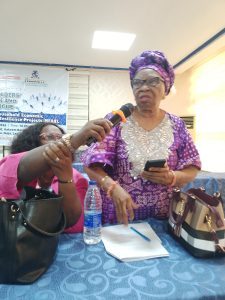
Beyond economic empowerment, the dialogue also examined women’s representation in governance. On special seats for women, he said: “One thing is that Nigeria has one of the lowest ratio for women in governance. However, there can be special seats for women to promote women representation.
“What you really need to do is to ensure that political parties should ensure that there is a specific number of women that should participate and get positions. We have many competent women, and we need to give space, the spaces in the political parties have unfortunately been hijacked by men. This may not be popular, but we need them to be involved.”
Addressing macroeconomic realities such as inflation and their impact on women-led MSMEs, he said: “These are some of the challenges that women are facing. There’s really little to what our money can get because of inflation. What we can do is to actually bring down the cost of inflation more so that we can have more value for what we have.
“Then we need to get behind what is going on right now. We’re a consumer nation, and we need to have a reorientation. We have to produce whatever we use, no matter how they are. We need to produce what we consume.
“Let us produce something little from the village level, from the community level. We have very high taste in Nigeria, we want to use the latest cars which we are not producing. We should be encouraged to produce whatever we are using, no matter how little.”
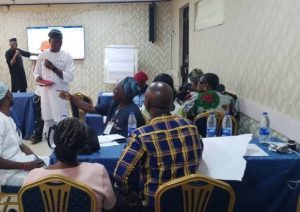
The workshop featured civil society actors, government officials from the Lagos State Government and members of the media. Breakout sessions enabled participants to interrogate practical policy options and recommend pathways for strengthening financial inclusion, expanding public-private partnerships and institutionalising support systems for women entrepreneurs.
At its core, the Stakeholders’ Consultation and Policy Dialogue underscored a central message: women’s economic empowerment must move beyond skills acquisition to include access to finance, financial literacy, enabling policies and sustained monitoring. Under the HEAR framework, stakeholders agreed that building household economic resilience is not merely a development goal but a strategic pathway to reducing poverty, stabilising families and strengthening local economies.