 National Wire About Nigerians, Nigerian Business and Other Stories


By Dayo Emmanuel
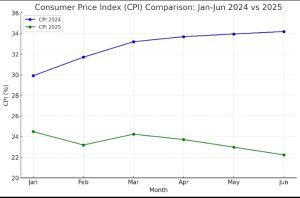
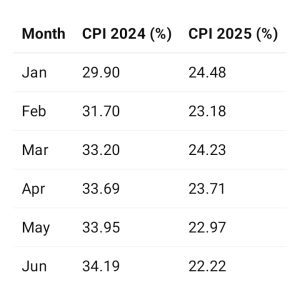
Despite the Central Bank of Nigeria’s projected inflation figure of 24% to 25% for the Nigerian economy in 2025, an improvement from the average of 34% to 36% earlier projected in 2024, the actual real-time Consumer Price Index (CPI) for the economy in the first half of 2025 has stood at an average of 23.4%.
Meanwhile, during the same period in 2024, the average stood at 32.77%, indicating a significant improvement in the economy. The improvement, however, may not be far from government efforts to enhance security, boost exchange rate stability, and implement improved policies.
At its 300th meeting in May 2025, the Monetary Policy Committee (MPC) of the Central Bank of Nigeria (CBN), with all 12 members present, after reviewing global and domestic economic developments, unanimously decided to retain key monetary parameters: the Monetary Policy Rate (MPR) at 27.5%, the asymmetric corridor at +500/-100 basis points, the Cash Reserve Ratio at 50% for Deposit Money Banks and 16% for Merchant Banks, and the Liquidity Ratio at 30%.
The MPC cited improvements in macroeconomic indicators such as narrowing foreign exchange market gaps, a positive balance of payments, easing PMS prices, and declining food inflation, credited to increased food supply and improved security in farming areas.
However, it warned of persistent inflationary pressures from high electricity costs, forex demand, and unresolved structural issues. According to the committee, in its report made available on the CBN website, headline inflation dropped to 23.71% in April 2025 from 24.23% in March, while GDP grew by 3.84% in Q4 2024. It also stated that external reserves rose to US$38.9 billion, covering 7.6 months of imports. Despite global economic uncertainties and lower oil prices, the MPC reaffirmed the stability of Nigeria’s banking sector and ongoing recapitalisation as members agreed to maintain current policies to stabilise inflation and exchange rates.
However, the implications of the slight improvement can be felt in the prices of food, but not in rent, as the cost of housing facilities in Lagos, Nigeria’s commercial capital, has continued to soar, likewise in Abuja the Federal Capital.
Dele Olugbenga, a consumer psychologist in Lagos, confirmed that, “Cost of house rents in Lagos area is becoming unbearable and the government of the day is doing nothing about it.”
According to him, “There should be regulations to make people have value for their money. For instance, a two-bedroom flat in Ayobo or Ipaja Lagos suburbs should not compete with what obtains in Ikeja or Surulere.”
Another respondent, Blessing Osemobor, said, “People’s income did not improve over the last two years but rent keeps soaring by the day.”
She is particularly bothered about the displacement of tenants around the Ogba area of Lagos, where many houses have been bought and demolished for new apartments.
“I feel for tenants and business people whose business premises have been demolished after landlords sold the properties,” she said, arguing that, “These people whose businesses have stabilised over time may not recover easily.”
The publicist of a civil society group, Community Pot; an NGO focusing on nutrition for vulnerable children, Osemobor said, “Poverty is also accountable for malnutrition and children are more vulnerable as food inflation is high.”
However, a food vendor, Yinka Adelakun, whose business premises was also sold and demolished recently on Kayode Street, Ogba, Ifako-Ijaiye, Lagos, confirmed that, “Cost of foodstuff actually reduced from what we bought in December.”
The proprietress of DANOCH Foods, now operating on 28, Kayode street, Ogba, Lagos, continued that, “A bag of rice went beyond ₦100,000 in December 2024, while in the first quarter of 2025 we got it below ₦75,000.”
She also noted that, “The price of a basket of tomatoes in May 2024 soared, and we were all afraid to the extent that some homes were improvising with cucumbers. But today, those are things of the past, though the prices should still reduce to support homes and businesses.” The commodity was almost unaffordable in the first quarter of 2024 while households resulted to cucumbers as replacement for tomatoes.
Reports from the first half of 2025 indicate a complex business environment in Nigeria, marked by economic stability efforts alongside persistent challenges like high inflation and operational costs.
According to Proshare, the global economy has been whiplashed by a variety of events, ranging from the global tariffs imposed on countries by the U.S. government in 2025 to a slowdown in growth rates across continents due to supply chain disruptions and rising input prices—except for a few Asian and mid-sized countries in sub-Saharan Africa (SSA).
The consequences are a forecast of slower global growth, which is expected to continue into 2026.
Meanwhile, Nigeria is expected to see gross domestic product growth of around 3.5% in 2025 and 3.7% in 2026 according to experts.
Exchange rate stability, lower inflation rate (after CPI rebasing), and rising crude oil output would likely undergird the relatively strong growth of the economy in H2 2025, according to the experts from Proshare.
There is hope for the Nigerian economy as further forecasts suggest it will progress steadily in H1 2025, with the key highlights being:
*Faster-paced GDP growth of between 3.5% and 3.7%,
*Domestic inflation expected to fall steadily towards 21% or lower over the next five months
*An increase in net reserves to between US$25bn and US$27bn by year-end
*Expected gross GDP to settle between US$39bn and US$41bn
The Monetary Policy Rate (MPR) will remain at 27.5% as the Central Bank of Nigeria (CBN) sticks to an aggressive anti-inflationary stance; however, the Cash Reserve Ratio (CRR) may be reduced modestly from the present 50% to 45%.
There are also forecasts that the naira-to-dollar rate may stay within the ₦1,550/$ to ₦1,600/$ band. However, due to resilience, the situation may improve further, with the naira expected to exchange below ₦1,500 before the end of 2025.
This would be lower than the forecast, despite some financial analysts projecting the rate to slip to ₦1,700/$ by the end of 2025. Much of the likely year-end exchange value of the naira will depend on international oil prices and crude oil production, which is improving in Nigeria.
Ultimately, the average Nigerian may not easily relate with the figures from the Central Bank of Nigeria or the country’s Bureau of Statistics, what the common man wants to see as improvement in the economy is real time prices of commodities especially food and cost of rent. The middle class who may understand a little bit of economics would take the understanding and expectations higher by expecting a stable exchange rate. But largely, the figures, policies and politics determine the cost of food in the market and reasons the Federal Government must up its game to secure the economy for the benefit of all.