 National Wire About Nigerians, Nigerian Business and Other Stories


Executive Director of CEE-HOPE, Betty Abah, has called on the Nigerian government to reduce or remove taxes on sanitary products across Nigeria to eradicate period poverty.
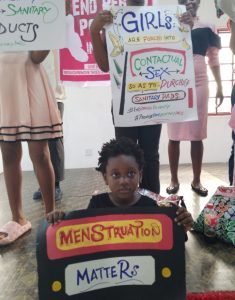
Abah made this appeal at a conference in Lagos aimed at campaigning to see the end of period poverty in Nigeria.
According to her, period poverty has impoverished women and girls in Nigeria and is responsible for low school enrollment among girls and a drastic drop in school attendance, all due to the insensitivity of the government at every level.
She also enjoined school girls to be focused on their studies and future careers at the conference attended by hundreds of school girls from Lagos communities.
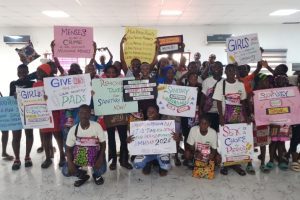
“We are using this opportunity to encourage you to be focused and know what you want to be,” she admonished. Continuing, she said, “If you are doing well, you will enjoy later in life.”
Abah, a multiple award-winning journalist, gave an example of herself growing up in the village. “I started schooling when I was nine years old in Benue State. Our village is remote and most girls there then did not go to school, but I was determined to be educated. I was prayerful also. God helped me, I was able to make a difference and set a good example,” she said.
Founder of Sanitary Pad Media Campaign, Anike-Ade Funke Treasure at the event also encouraged the girls and talked about the need to take their menstrual hygiene seriously.
Commending Betty Abah and the engagement of CEE-HOPE, especially in the area of ending period poverty in Nigeria, Anike-Ade Funke Treasure said the initiative is a step in a good direction.
“It is a good initiative, I think it’s a step in the right direction. Betty Abah has done well by bringing the children together to talk about period poverty and policy intervention. I think the children are not too young to learn about policy intervention.
“I think period poverty is all-encompassing and it affects everyone, so I think this conference is nice and Betty Abah has hit the nail on the head on this one,” she said.
Talking about what Nigeria can learn from other countries doing well in terms of policy to end period poverty, she said there are African countries and others outside the continent Nigeria can learn from since they are there already.
“Nigeria can learn more and learn a lot from Scotland, Zambia, an African country that has done that. Look at Scotland that has free pads for students. We know that Kenya started it, but we don’t know how it’s going. I think the project is lacking funding, but there are other places in the world where this is done.
“Like I said in my speech, Nigeria can afford it. If we have extra money to spend on some less important things, then we can do this,” she said.
With many women in the National Assembly, she expects changes in policies in favor of the girl child soon.
“Our women are pushing pads to girls in schools, but what we lack is the collective efforts to press on policies. What we do now is individual efforts, but the time is now to come together collectively and push. If we have to look at the glory going to one person, we won’t get there, but it is to all of us. It is a collective thing.
“The men that we talk about that form a critical mass in taking decisions are our fathers, our husbands. They know when we have fibroid issues; they have daughters. It’s not something strange we are asking for. If so many women are given, it shows that there is a need and it’s about time we came together to start pushing at the state and at the federal legislative arms,” she said.
Relaying when she started her initiative, she said, “When I started Sanitary Pad Media Campaign in 2020, somebody said to me Nigeria cannot afford it. Don’t you know how much Nigeria has spent on other things?
“Beta Edu squandered how much? But we continue to make excuses for the government. We continue to say we are broke. Where do they get that money from? Nigeria is not broke. Nigeria can spend the money to pad the girls,” she argued.
She also responded to how the harsh business climate is affecting companies that produce sanitary products. She observed that sanitary products are among the top ten items that are most expensive in Nigeria and it is about the business environment that is driving companies producing sanitary products away from Nigeria.
She, however, commended the Lagos State government as one state that pays attention to menstrual health.
She looks forward to continuous collaboration between individuals, corporate bodies, organizations, and the state.
Founder of Save Our Women and Girls, Ambassador Unyime-Ivy King, at the event said the government can subsidize sanitary products so they can be accessible to girls.
“One of the things the government can do is to supplement the money people use to bring in the pads because I know that a lot of these pads are foreign,” she said. Continuing, she said, “The government may reduce the tax if they cannot remove the tax totally and give girls the pads for free because I know that the amount of money the government uses on things in other sectors can easily be channeled to provide these pads for the girls in Nigeria,” she said.
She also advocated for legislation to support women who lose their husbands because of the dehumanizing treatment they get in some cultures.
The conference featured other speakers, including Mrs. Funmi Falobi, a journalist and mass communication lecturer, and Pastor OluwaTobi Alli, an author, conference speaker, and pastor, who both motivated the student participants to shun distractions and be the best they can be.